
Context Engineering
30 min · 4,012 words
- Explain context rot and why a model degrades before its window is full
- Say what context engineering decides, and why the decision repeats every turn
- Apply summarisation, offloading, a knowledge base, subagents and explicit planning
- Name what a deep agent must have, and why coding agents are already one
- Explain how chain of thought keeps a long session on track
Prompt Engineering was about writing one good input. This module is about everything else that goes in front of the model. It is also about one problem: there is not enough room for all of it.
After prompt engineering came context engineering. It became the trend of late 2025. Here we cover where it came from, how it developed, and the techniques that are worth knowing.
Rise of Context Engineering
Back then, the whole discussion was about size. People wanted models with larger context windows. They gave the model more and more, because more context really did give better results.
If you have ever worked through a long session with a coding agent, you know the feeling. You brainstorm, you design, you go back and forth. Then, with no warning, you are at 95% of the window. Because more context helped, people kept adding extra material to their prompts. That made the window fill faster than ever.
So what did systems do when the stack grew bigger than the window? Mostly, they used a sliding window. Say the model holds 1M tokens, and your history has reached 1.4M. The window slides forward, and the model only sees the last 1M, from 0.4M to 1.4M. The first 0.4M is gone.
That is worse than it sounds. The moment you cross the limit, you have to drop the oldest context. That is usually where you explained what you were trying to do. So the shared understanding you built with the model is the first thing the system throws away. You are left copying your own earlier prompts back in by hand, to remind the model what the job was.
Context Rot (Pollution)
While everyone was looking for ways around a full window, the Chroma team published Context Rot: How Increasing Input Tokens Impacts LLM Performance. Its finding was a big surprise: as the context grows, the model gets worse at the task.
They tested 18 models, including GPT-4.1, Claude 4 and Gemini 2.5, and the pattern was the same in all of them. Give the same model the same job, and it does the job noticeably better with 25K tokens in its context than with 800K. It is not because the window overflowed. It is because of what was already in it.
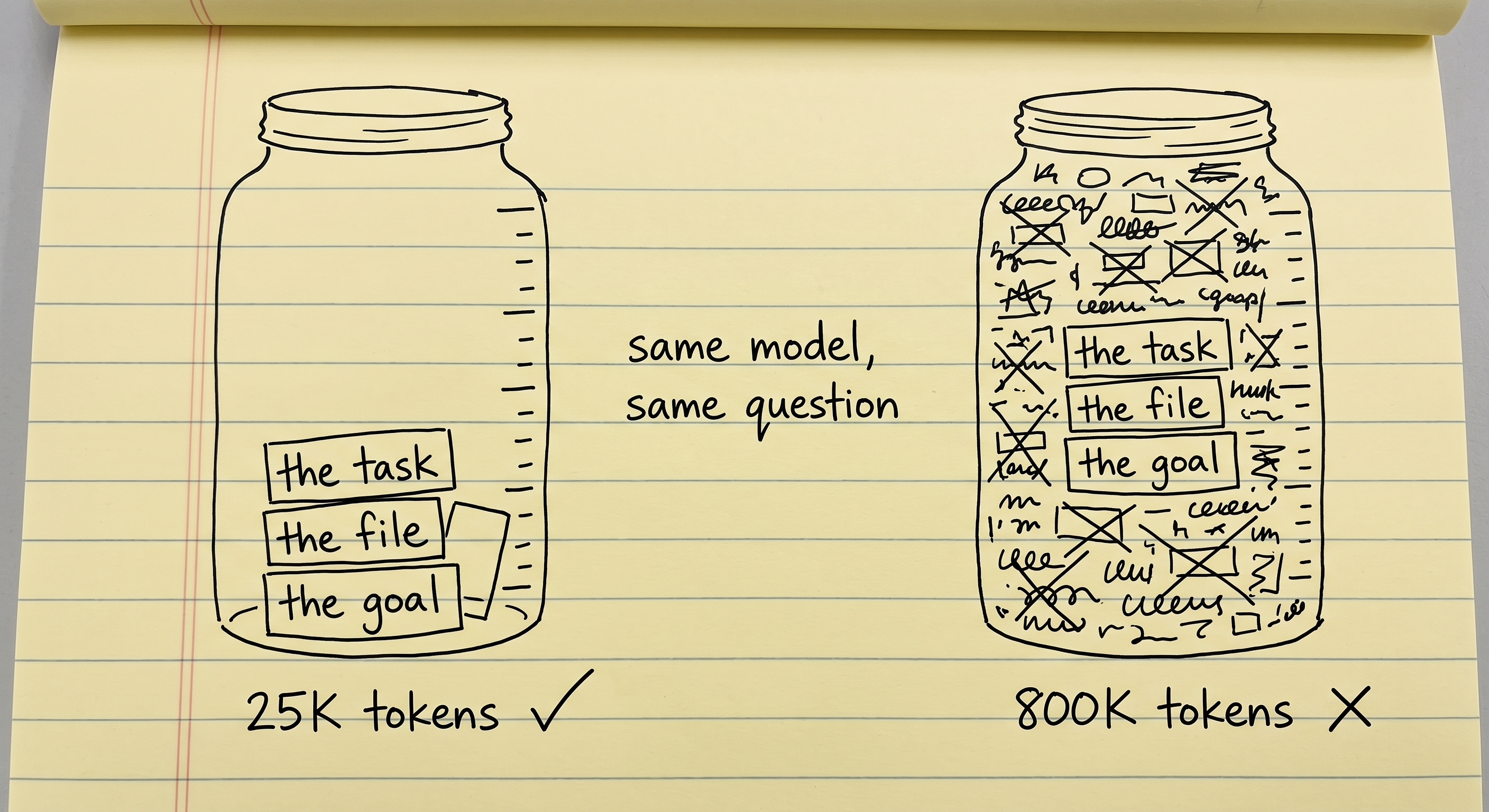
The three things the model needs are in both jars. On the right they are still there, still readable, and still lost. Everything else in the jar is competing for the same attention.
People use two names for this effect: context rot and context pollution. Drew Breunig's How Long Contexts Fail goes one step further. It names four specific ways that it happens: poisoning, distraction, confusion and clash.
The reason is attention. Attention is the mechanism a model uses to decide which parts of its input matter for the token it is about to write. We are not going into the theory here. What you need is the result: attention is a fixed budget, and the model divides it across everything in the window. A person works the same way. You can hold a few things in your head at once, and no more. The model that is your agent's brain is no different. Fill its context with a lot of loosely related material, and it carries the same load a person would. It also makes the same kind of mistakes.
Be careful about one point, because it is the part people get wrong: this is not the window "filling up". Performance starts to drop long before you reach the limit. A window that is 40% full can already give worse answers than the same window at 5%.
Here is what it feels like in practice. You start a long session to write a book. At the beginning, you tell the model to write in a clear academic tone. For a while, it does. Somewhere past 800K, it stops: the tone drifts to something vague and chatty, and the model starts to invent things. Nothing was deleted, and the window never overflowed. The instruction is still there. But its share of the attention had to compete with everything you added after it, and it lost. The model has lost the map, which means it no longer keeps track of the goal you set at the start.
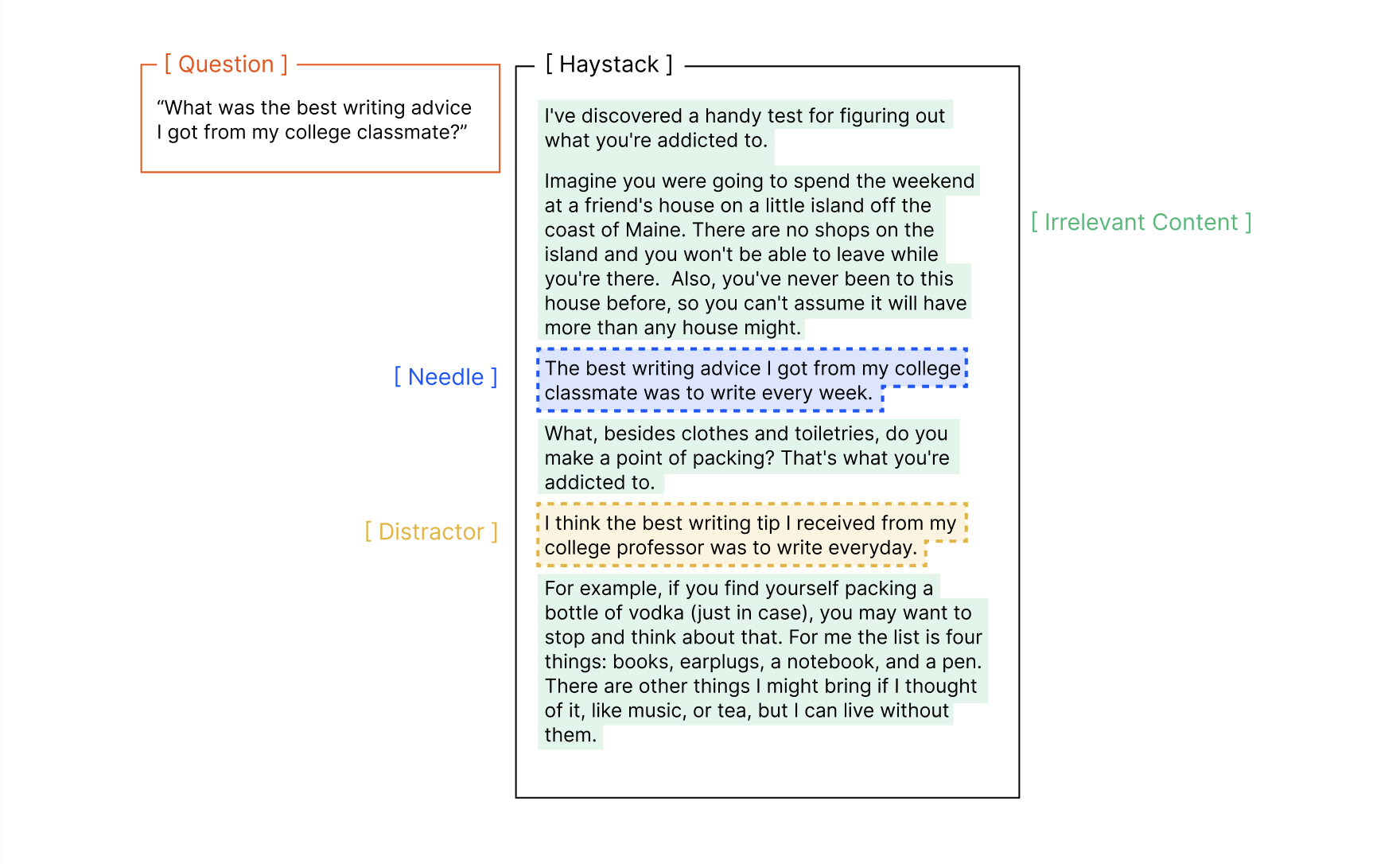
The question asks for the classmate's advice. The needle answers it. The distractor is the same sentence, but about a professor. Chroma found that one distractor is enough to hurt. They also found that the less the needle looks like the question, the faster performance collapses as the haystack grows.
You will hear the name of that test all the time: needle in a haystack. The version above is the harder one. The easy version hides an exact phrase in the text and asks for it back. Models do that almost perfectly. Chroma's contribution was to hide something you have to reason to find, and to put wrong sentences that look almost right beside it.
Out of all of this came a set of practices, and a name for them.
What is Context Engineering?
Context engineering answers one question: what should go into the context, and what should be kept out of it?
The window is limited, so something has to decide. There is a constantly growing universe of things that could go into the window. Context engineering is the art and science of choosing which of them actually go in. The goal is to have as many tokens as possible that carry real signal, and as few as possible that are noise, so that the context does not rot.
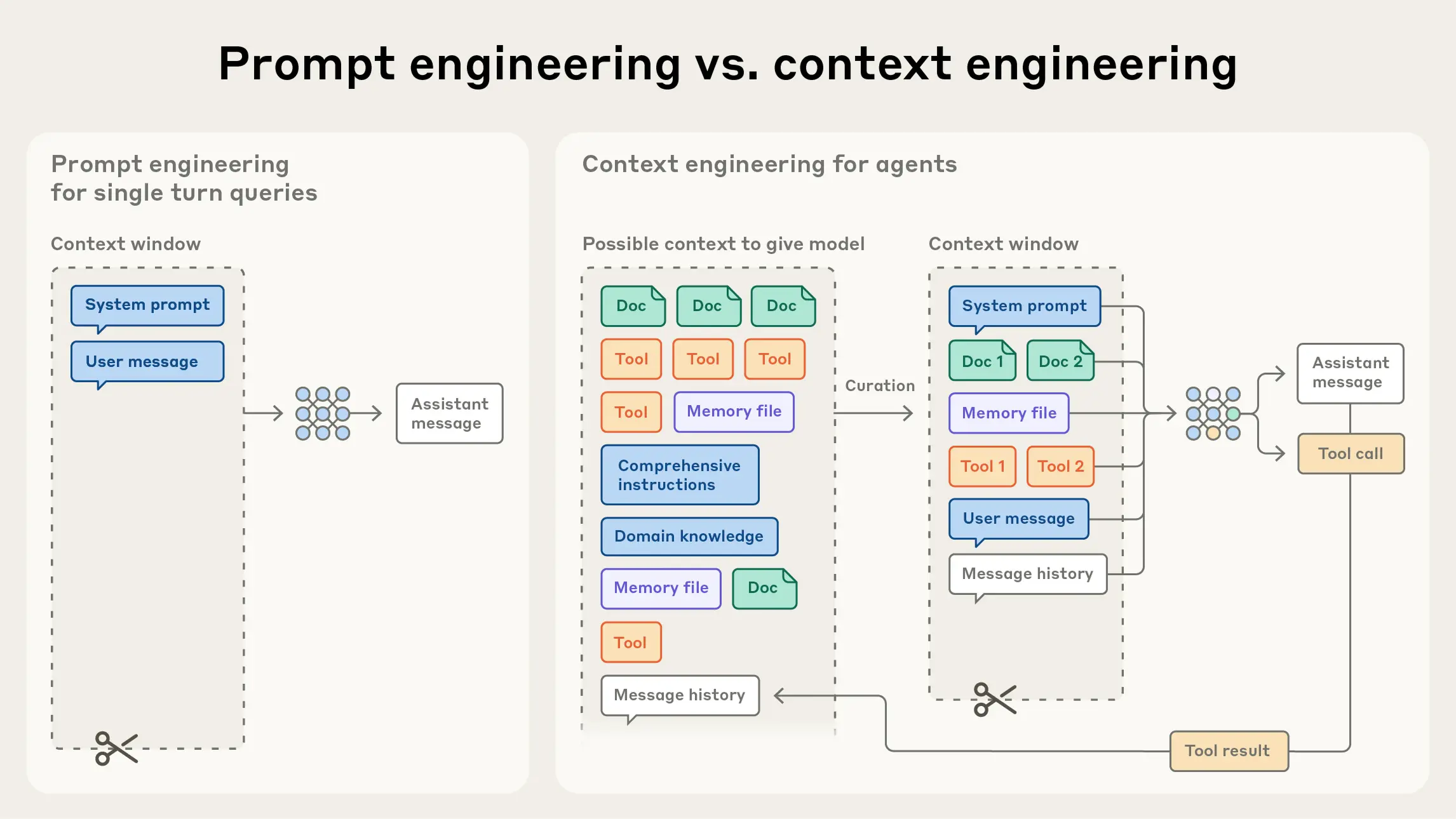
On the left is one turn and one decision: that is Prompt Engineering. On the right is a universe of things that could go in the window, and a decision about what actually goes in. That decision is made again on every single turn.
The term became popular after a post by Andrej Karpathy in mid-2025. Anthropic's Effective context engineering for AI agents gave it the most complete treatment. It calls context engineering "the set of strategies for curating and maintaining the optimal set of tokens during LLM inference". Philipp Schmid's The New Skill in AI is Not Prompting, It's Context Engineering describes the same idea as a job description: give the model the right information and tools, in the right format, at the right time. LangChain sorts the techniques into four verbs: write, select, compress, isolate. You can find this sorting in Context Engineering and in Lance Martin's Context Engineering for Agents.
Here are the techniques that are worth knowing now.
Context Summarization (Compaction)
This is the simplest one. When the context gets long, replace it with a summary of itself. This way, 800K tokens of conversation become 20K tokens of "here is what we decided, here is what is still broken, here is where we were".
Most agents now do this on their own when they get close to the limit. Some also let you start it
yourself. In Claude Code, you type /compact and it happens immediately.
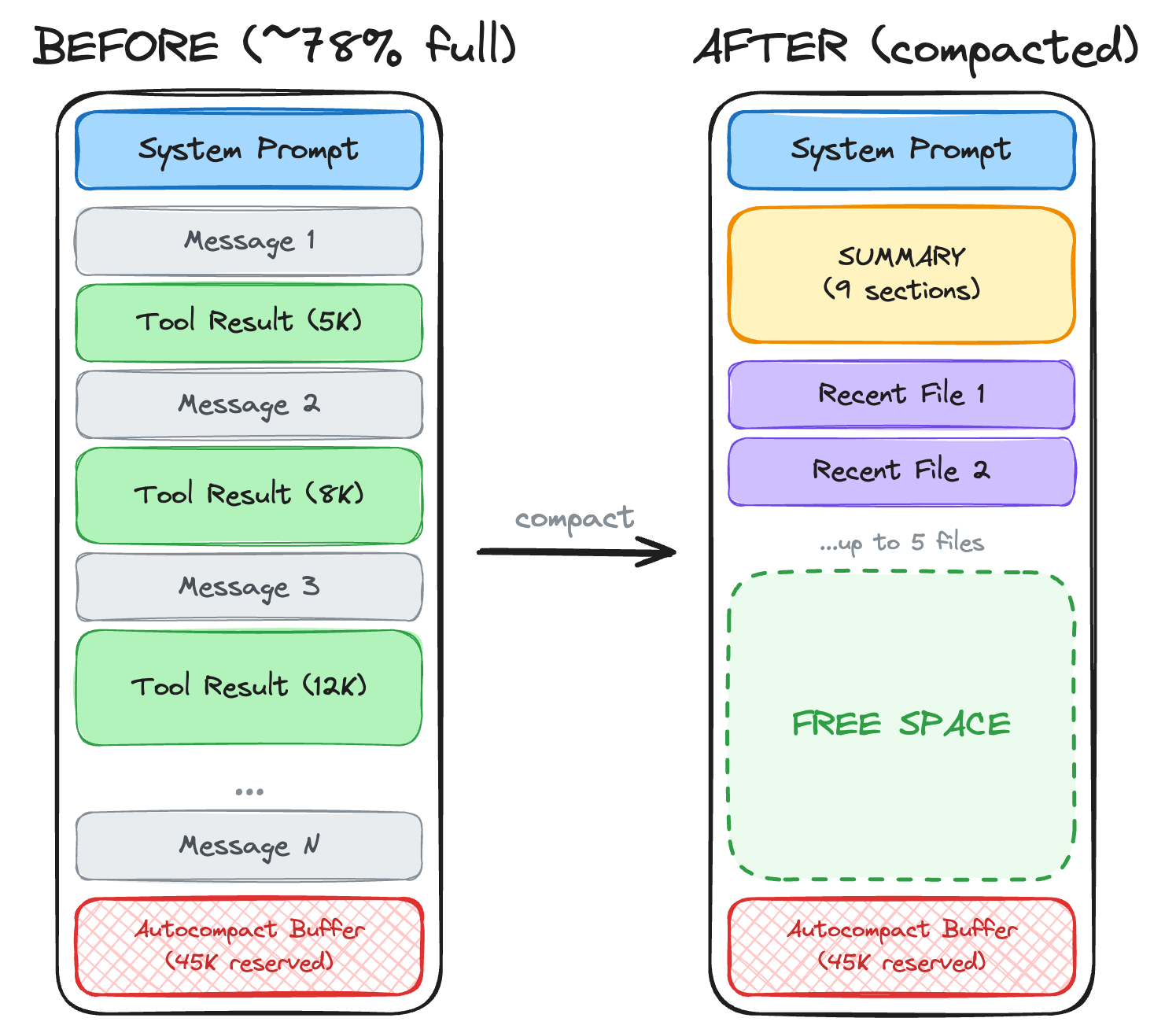
Notice what is kept and what is not. The tool results are most of the window, and they go. The summary keeps the decisions. The few recent files are kept, because the agent will read them again immediately. The reserved block at the bottom is space the agent holds for its own summarising. This way, it is never caught with a full window and no room to write.
The cost is real, and it is worth saying plainly. A summary throws away the 40,000-token output of a terminal command that nobody needs again. That is the point. But it can also throw away something you did need. This can happen by accident. It can also happen because whatever wrote the summary decided that the thing was unimportant, and was wrong. For exactly this reason, Anthropic's own guidance on compaction says to keep architectural decisions, unresolved bugs and implementation details.
Context Offloading
Instead of keeping something in the context, the agent writes it down in a place where it can read it later. Usually that place is a markdown file. The important facts leave the window and live on disk. The agent fetches them back when it actually needs them.
The Manus team wrote about this in Context Engineering for AI Agents: Lessons from Building Manus. They describe it as using the file system as context. The file system is unlimited in size and persistent by nature, and the agent can work with it directly.
Many agents build this into a feature called long-term memory. It is an index of the things worth keeping. So even after the context is summarised, the facts survive, and the agent can still search them.
The same warning applies here, and it has the same root cause. Deciding what is worth keeping is a matter of judgement, and that judgement comes from either you or the model. Both get it wrong. Losing something valuable this way is common, not rare.
Memory divided memory into parametric, working and long-term. This is the long-term one. In practice, it is usually organised into three kinds:
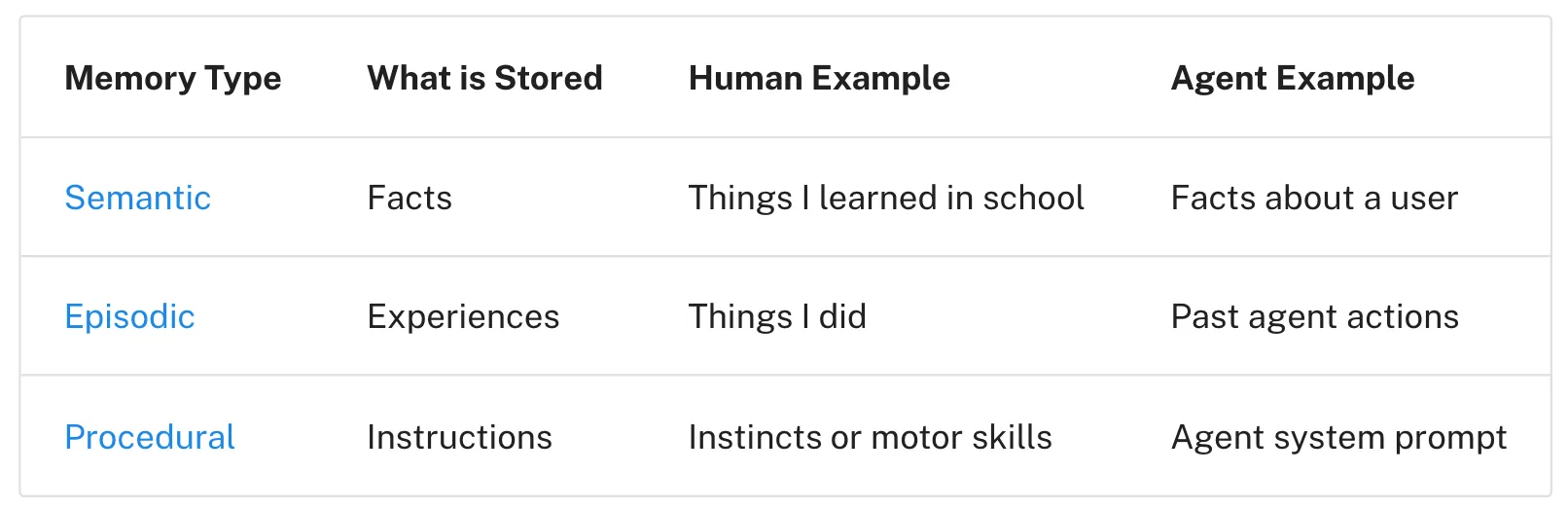
The split matters because the agent writes and reads the three at different times. Facts about you collect quietly over time. Past actions are what stop an agent from repeating a mistake. And the instructions layer is just the system prompt from Tool Calling under another name.
Using a Knowledge Base as Explorable Context
Some information is really valuable and does not change often, such as how your company's internal API works. Do not paste it into every prompt. Put it in a place where the agent can go and look: a folder of markdown files that it can read and search.
Then, when the agent decides it needs your documentation, it retrieves it. It reads the part that matters, and learns that much in context. Retrieval can be full RAG from RAG & Embeddings, or just an agent opening files. Either way, the alternative is to dump the entire API reference into the window and pay for it on every turn.
One tool is worth knowing here. DeepWiki generates a wiki for a GitHub repository. Say your agent has a question about a library's internals, its architecture or its API. It can read DeepWiki's write-up, instead of crawling the repository itself and filling its context with source files.
Context Isolation
Here is the example that makes this clear.
Your coding agent needs to tell you what architecture a repository uses. The repository is a million lines long. To answer, the agent has to open a lot of files. Say that costs 800K tokens of context, and the answer is one sentence: the system orchestrates an event-driven microservices fabric, blending distributed Kafka streams with real-time geospatial processing. You spent 800K tokens of context to get one sentence. And now that 800K sits in the window, rotting everything that comes next.
The fix is to not do the reading in that context at all. The main agent calls a second agent that has an empty context of its own. This second agent is a subagent. The subagent does the 800K-token crawl. It throws away everything except the conclusion, and it hands back the sentence. The main agent's context gains one sentence.
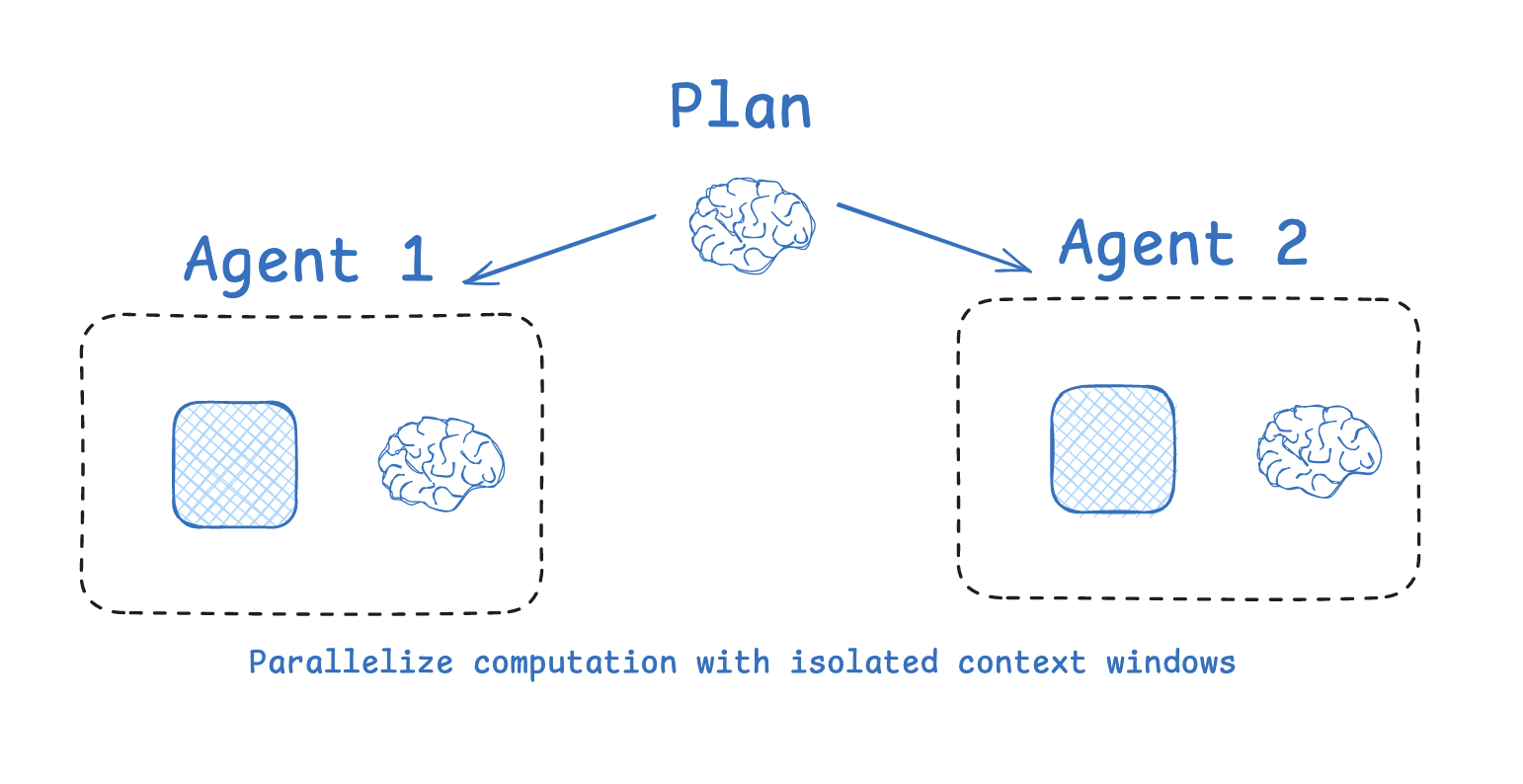
Each box is a separate context. It starts empty, and it is thrown away when the work is done. The main agent never sees the intermediate steps, and that is the whole point: because those steps never reach its window, they cannot fill it and make its answers worse.
How it works. A subagent is a new agent with a clean context. The main agent calls it in the
same way it calls any other tool, with something like
Task("find out what architecture this repo uses"). From the point of view of
Tool Calling, nothing new is happening: a tool was called, and a tool
result came back. The subagent runs its own loop and hides every intermediate step. Then it returns
the final answer as that tool result. Anthropic reports that these summaries are usually around
1,000 to 2,000 tokens.
Modern agents call subagents one after another or in parallel. This leaves the main agent free to do what it is actually good at: holding the plan and deciding what happens next.
Explicit Planning (TODOs)
Say you ask an agent to build you a portfolio site. That means all of these steps:
- defining the scope
- choosing a stack
- building the layouts
- writing the content in
- wiring up a CMS
- configuring deployment
If the agent starts writing code straight away, it will lose the map. It forgets a step, or it drifts somewhere else entirely. So instead, it writes the plan down first. The plan is a to-do list, with a state on each item:
[x] Define the scope: one page, three projects, a contact form
[x] Choose the stack: Next.js, static export, no database
[~] Build the layouts: header and hero done, project grid in progress
[ ] Write the content in
[ ] Wire up a CMS
[ ] Configure deployment
Then it works through the list. After each step, it goes back, marks what it finished, and takes the next one. The big task became small tasks. There is now a written record of which ones are done, so nothing depends on the agent remembering.
The second effect is less obvious, and it matters more. Each time the agent re-reads and rewrites that list, it brings the goal back into recent context. This happens over and over. Manus calls this manipulating attention through recitation. It is the most direct answer to the academic-tone problem above. The instruction loses its share of attention because nothing repeats it. A to-do list repeats it.
Remember the word recitation. It comes back at the end of this module, because the to-do list is not the only thing that does it.
How it works. Modern agents offer this as a built-in tool. If your agent does not have one but it can reach a filesystem, it can keep a markdown file and get the same result.
NOTE
these are not all of the techniques. Advanced Context Engineering covers the harder ones, especially for software work.
Deep Agents
Deep agents are an agent architecture that became popular while all of this was happening. You do not have to build every technique above into your own agent by hand. A deep agent is the shape that packages them together. There are several architectures worth knowing, and Advanced Agent Architectures covers them. This is the one that belongs in this module, because it is context engineering turned into a design.
To count as deep, an agent needs at least these:
Rendering FIG. 10.7
Philipp Schmid's Agents 2.0: From Shallow Loops to Deep Agents adds a fourth: a very long and very specific system prompt. It is sometimes thousands of tokens long. It tells the agent when to plan, when to spawn a subagent and how to organise its files. NVIDIA's What Is a Deep Agent? describes the same architecture in the same terms. You will also hear the whole idea called Agents 2.0. It is the same thing under another name. That name makes the break from the plain loop of AI Agents sound as big as it really is. The Agent 2.0 Era: Mastering Long-Horizon Tasks with Deep Agents walks through it from start to finish.
To build one, the simplest place to start is deepagents from LangChain. It calls itself a batteries-included agent harness. That means it comes with the main parts already built in, so you do not have to add them yourself. The batteries are exactly this list:
- planning
- a pluggable filesystem
- subagents with isolated windows
- summarisation of long threads
The Deep Agents overview is the documentation.
Here is the real benefit: a deep agent does most of the context engineering for you. It summarises, it offloads, it delegates, it plans. You do not have to wire up any of it. Some techniques still need a human, and those are the problem of the advanced module.
And here is the thing to notice: most agents you already use are deep agents. Claude Code, Codex, Copilot and OpenCode all have planning, subagents and a filesystem.
Long-horizon Tasks
When you put all of this together, something new appears: agents that work for hours without anyone watching them.
You have probably seen someone get a whole website, or a working game, out of a single prompt. Those are long-horizon tasks. They became possible because of the techniques in this module. Think of an agent that can do all of these things:
- break a huge job into steps
- plan those steps
- write its own notes
- offload what it does not need
- spawn subagents for the expensive parts
- summarise its own context
That agent can keep going long past the point where, before, it would have lost track of the task.
There is a real measurement of how far this has come, and it is more useful than the marketing. METR's Measuring AI Ability to Complete Long Software Tasks asks a simple question. Take the tasks that a model finishes about half the time. How long do those tasks take a human? That number is the model's time horizon. When the paper came out, Claude 3.7 Sonnet was at roughly 50 minutes of human work. The trend line has doubled about every seven months since 2019. If you extend that line, month-long tasks arrive within five years. METR keeps the current numbers for each frontier model on one chart, at both 50% and 80% success. That chart is the honest way to read a claim that some agent "worked for six hours".
Long-horizon is the keyword of 2026, and every company is chasing it. They chase it because it is the difference between an agent that helps you work and an agent that does the work. If you want the research landscape rather than the headline, look at Awesome-Long-Horizon-Agents. It is a reading list that is kept up to date. It sorts the whole field into two parts: what you build around the model, and what you change inside it.
Chain of Thought as a Context Engineering Tool
There is one last thing, and it sits exactly between this module and the previous one.
Chain of thought from Prompt Engineering does more than improve one answer. It also keeps a long session on track. When the model writes out its reasoning, it repeats the goal to itself. Take the book that drifted out of its academic tone. With reasoning turned on, the trace at that same point in the session looks something like this:
<thinking>
The user wants section 8, which is about slang in American society. Before I
start: their instruction from the beginning of this project was a clear academic
tone throughout, and that has not been withdrawn. The subject is informal, but
the treatment of it should not be. Academic register, slang only as quoted
examples.
</thinking>
Nothing was retrieved, and nothing was added to the window. The model wrote the instruction back into its own recent context, where attention is cheapest.
That is the same move the to-do list makes, and it is why the word recitation was worth remembering. Both techniques work by saying the important thing again, close to where the model is about to write. A to-do list recites the plan. A chain of thought recites the constraint. The model gives more attention to text that is close to where it is writing, and to text that appears more than once. So if you want the model to still care about something at 800K tokens, something has to repeat it. Left alone, it fades. That is chain of thought working as a context engineering tool. It is also the cheapest tool in this module: you do not build it, you turn it on.
Summary
A context window is limited, and its quality drops before it is full. More context makes the answer worse. That is the opposite of what everyone assumed in 2025. The reason is that attention is a fixed budget, divided across whatever is in the window.
Context engineering is deciding what earns a place in there. All the techniques are versions of the same move: get the tokens out of the window, and keep a way back to them.
- Summarise the history.
- Offload facts to files.
- Leave documentation where the agent can go and read it.
- Hand expensive work to a subagent with its own window.
- Keep a to-do list that recites the goal back into recent context.
A deep agent is an agent that does most of this for you. That is why the coding agents you use every day are already deep agents.
Next: the coding agents themselves, and the six ways you extend one.
References
📄 Articles
- Context Rot: How Increasing Input Tokens Impacts LLM Performance: the Chroma study behind all of this, 18 models, and the needle-and-distractor experiments
- How Long Contexts Fail: Drew Breunig's four named failures, from an early hallucination that keeps getting cited to new information that contradicts the old
- Effective context engineering for AI agents: the most complete treatment, and the source of the compaction and subagent guidance
- The New Skill in AI is Not Prompting, It's Context Engineering: the shortest good definition
- Context Engineering: the four verbs (write, select, compress and isolate)
- Context Engineering for Agents: the same four, with diagrams that are worth reusing
- Karpathy on context engineering: the post that put the term in front of everyone
- Context Engineering for AI Agents: Lessons from Building Manus: specific lessons from real experience, especially the filesystem and recitation lessons
- Agents 2.0: From Shallow Loops to Deep Agents: what makes an agent deep, and why it is an architecture rather than a feature
- What Is a Deep Agent?: the same definition, stated plainly
- The Agent 2.0 Era: Mastering Long-Horizon Tasks with Deep Agents: the same architecture, explained from start to finish
- Context Engineering: How Deep Agents Remember: how deepagents keeps the context of a long run small (offloading, summarization, skills, subagents and memory files), and why memory kept as plain files lets you change models
- Measuring AI Ability to Complete Long Software Tasks: where the time-horizon number comes from, and the doubling trend
- Task-completion time horizons: the current numbers per model, kept up to date
🎬 Videos
- Stop stuffing your context window (here's why): the short version, if you would rather watch
🛠️ Tools
- DeepWiki: a wiki per repository, so your agent reads about the code instead of reading the code
🗃️ Repositories
- deepagents: the library, and the Deep Agents overview that documents it
- Awesome-Long-Horizon-Agents: the research landscape, sorted, if you want to go deeper than this module
🧭 Modules
- Advanced Context Engineering: the techniques this module left out
Want a quick quiz?5 questions on the main points of this module
What is context rot?